Preparing your fields for multiple sports
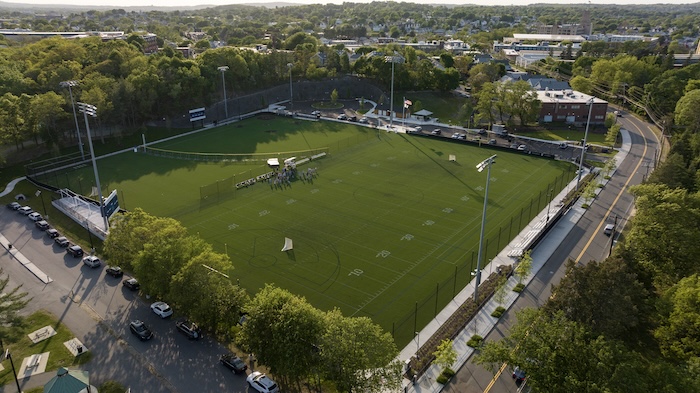
They work hard at sports for three and sometimes even four seasons continuously. They also help host graduations and the occasional community concert or fair. So why doesn’t your athletic field have a varsity letter?
Yes, that was a joke, but it’s essential to remember that fields do get pressed into service quite a bit, and that quite a lot is expected of them. In addition to hosting football, they also support soccer, lacrosse and even field hockey. During the summer, when school is out, they may be the home of tournaments, sports camps or skill clinics.
Multitasking facilities need smart field design
As society has become increasingly landlocked, space to build new athletic fields may be scarce or even nonexistent. Therefore, the question becomes how to help fields host more events. Design professionals are entering the chat with creative methods to increase options.
Without entering into a debate on the merits of grass fields vs. synthetic turf, synthetic fields generally have the edge when it comes to getting heavy use throughout the playing season. They don’t get worn, skinned or rutted, and they can withstand multiple games even after a rain event.
That’s not to say grass can’t be just as valuable an asset; however, a natural field will need to be rested between periods of heavy use, meaning play must be rotated to other areas during those times. Additionally, after an extended rain, the field will need to drain and dry before it can be used again.
Line marking
It is common to see rectangular fields marked for football and soccer. In many cases, governing bodies specify white playing lines; however, with two, three and sometimes more sports being played on the same field, other colors must be used. In such cases, builders advise using white for the dominant sport on the field (in many cases, this is football). Something that has become commonplace is the use of yellow for soccer lines, red for field hockey and blue for lacrosse, although many other colors are used. In some cases, school colors are chosen (for example, purple and gold) for various playing lines.
As other sports gain prominence (rugby, for example, is an NCAA Emerging Sport for Women, and flag football is growing astronomically at both the college and high school levels), expect there to be even more demand for different field markings. Robotic line-marking machinery has even been adapted; many models now have tanks that can store several colors of paint.
Some schools wish to avoid the so-called ‘spaghetti bowl’ look caused by multiple lines. As a result, many fields have tick marks to delineate playing areas, while in other programs, plastic cones or corner flags are used.
Remember that while grass can be marked for various sports, it is inadvisable to put any paint onto a synthetic field without first consulting the surface manufacturer. Even paint that is marketed as being washable may not come out.
Hosting diamond sports with rectangular fields
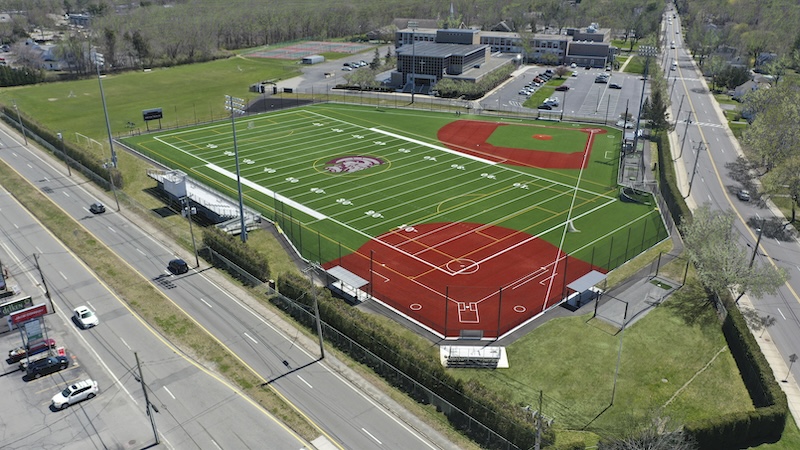
In cases where space must be optimized, designers and contractors are working together to help schools leverage one or two fields to host not only football, soccer and lacrosse but baseball and softball as well.
Often, rectangular fields are laid out in the outfield; there are multiple examples of synthetic fields where this is the case. Additionally, many schools have been installing movable fencing to allow fields to be converted quickly. If the fencing will be used with a diamond sport, the top rails should be padded to allow players to attempt challenging plays.
Small-sided play
The youth tournament market was one of the first sectors to have widespread use of small-sided fields: smaller playing areas designed for children to learn their sport. Such games have fewer players per side, allowing for more touches on the ball and a faster learning curve. Lightweight, portable goals are used for each playing area.
Fun fact: Small-sided play is surprisingly popular in adult sports social league play as well. Adults find it easier to find enough people for a smaller team, while the more compact field means less wear on joints.
Many schools that host youth camps or tournaments over the vacation season will find that the event owner plans to use fields for small-sided play; if this is the case, ask how the fields will be marked, and lay out any rules in advance concerning what products can be used.
Community use
Graduations and concerts are good examples of times when a field may be used for something other than sports. While grass fields should not require much special preparation (providing the weather is amenable and there have been no rain events to create muddy conditions), synthetic turf will need to be protected.
This may be accomplished in various ways. Some schools have used sheets of plywood or special temporary flooring, while others have purchased turf-specific floor coverings that lock together. Talk with your turf manufacturer to get their recommendations and discuss how to protect the surface from damage from any heavy structures and equipment that will be used.
» ALSO SEE: Seven must-read books for coaches and athletic directors in 2026
One event that should never be hosted on or near a synthetic field, say industry experts, is a fireworks display. Falling debris can cause melted, scorched and burned areas on the turf.
One resource that could be useful for those working to maximize the use of their fields is the publication, Sports Fields: Construction and Maintenance Manual. The book is published by the American Sports Builders Association and can be ordered in either hard copy or PDF format by going to the website, sportsbuilders.org and from the top blue toolbar, selecting “Resources,” then “Publications” from the drop-down menu.
You Might Also Like