The year-round blueprint for strength, speed, and durability for your football program
As strength coaches, it is our job to minimize our athletes’ risk of injury while maximizing their overall athletic potential. When designing our training, we should see a program that varies in intensity and volume, while building on itself.
The general calendar of the year and goals are:
- Off-season — strength and speed, lean body mass, work capacity
- Spring season — strength gains, utilization of previous gains
- Pre-season — peak sport-specific conditioning, power, and acceleration
- In-season — maintain power output.
Reducing the risk of overtraining
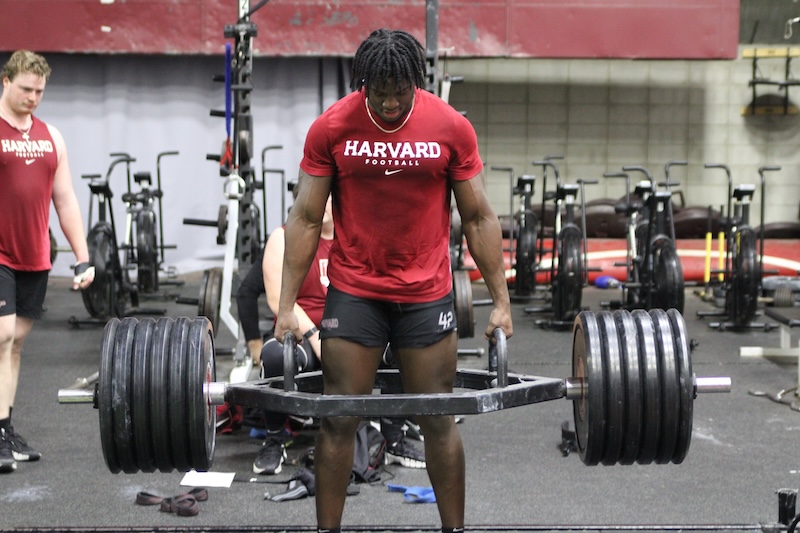 We want to make sure that our program builds on itself in a way that reduces the likelihood of injury and overtraining. So, we need to understand the causes of some injuries. Injuries are usually a product of cumulative stress, and overtraining tends to be “too much too soon”.
Every training day offers a stress load to the body, which, unless the athlete can recover from the load, will eventually lead to injuries. So, our goal as a coach is to figure out the minimum effective dose needed to achieve our goals. This minimum dose should allow us to achieve our lifting goals while recovering from each training stimulus between each session.
To help minimize overtraining, we should be structuring our program with a progressive overload approach. The highest risk of overtraining is after prolonged periods of rest. When coming back into training, we should be looking to follow the recommended return to play protocols from the
NCAA, CSCCa and the NSCA (Caterisano et al). The main recommendations are:
- A 20% reduction in training and conditioning loads in week 1, 10% reduction in week 2 for returning athletes.
- A 50% reduction in loads week 1, 30% week 2, 20% week 3 and 10% week 1 for new athletes.
These are of standard conditioning and lifting loads. We typically use our practice and game GPS data to understand the load reductions. If there is no access to GPS data, whatever conditioning test loads used should be the standard from which the reductions occur.
Offseason training
All of our football training is designed to get our athletes ready to compete at the highest level during the season. The winter off-season training phase is going to be one of the most important times of the year. Our off-season goals are:
- Improve strength and lean body mass
- Improve speed characteristics (acceleration and top speed)
- Improve our General physical preparedness (GPP)
Without the large quantities of conditioning, winter is one time when strength can be achieved at high levels through increased lifting volume. This increase in volume will also lead to increases in lean body mass for our athletes.
Speed training is another area of great importance during the winter. The three main components of our speed training are acceleration, top-end speed and agility. These areas are great indicators of performance on the field. Acceleration is the ability to achieve top speed in the shortest amount of time. Top-end speed is our maximum mph run. Agility is the ability to change direction with minimal deceleration.
General conditioning is the last part of the off-season training cycle that should be incorporated.
General conditioning is a great way to improve overall work capacity. This type of conditioning is going to be competitive and involve non-traditional conditioning methods. Training splits are:
- Day 1 — Acceleration work and lifting
- Day 2 — Competitive change of direction work and lift
- Day 3 — Top-end speed and lift
- Day 4 — General conditioning and lift.
Spring season
After the offseason, the spring becomes a great time to put those new skills and strength to
use. Strength increases without performance increases means our goals aren’t being met.
During this second season, practices will cover the speed and conditioning work, so our emphasis will be on continuing to improve strength and power outputs. To ensure we aren’t overtraining or causing injuries, we will typically have less overall volume in the weight room. We will still lift heavy, but we look to minimize total sets and reps.
Pre-season
Our pre-season cycle is our most important. During this time, we must build a conditioning foundation that will allow our athletes to make it through practices during camp. We also need to develop peak speed, agility, power, and specific skills for football. This is not to say that strength still doesn’t need to be developed during this time, but getting our athletes prepared for the upcoming season should be the focal point. Our pre-season training goals are:
- Preparing for the rigorous demands of pre-season camp
- Improving peak speed and agility
- Continuing to improve strength qualities
It is important to monitor the overall volume of running at the end of each workout session. The large quantities of running can make overtraining a real possibility. The objective is to progress the running throughout the course of the summer, with the total volume of running peaking just before camp. Typically, we will rotate our days of high-volume running, high-intensity running, and recovery running to ensure that our athletes aren’t overtraining.
Our goal for the end of summer is to have all our athletes healthy, in shape, and ready to practice.
In-season training
The in-season training phase is where all the hard work of the past year should show. The objective of this training should be: maintaining peak power.
» ALSO SEE: Why the NADC is the most critical week on my calendar
Most colleges and high schools will practice six days a week during fall camp, and three to four days a week once games begin. Athletes will get one day off a week. This means we need to watch our volume in the weight room. Our programming should be designed to keep them performing at a high level for the entire season. As the year progresses, the focus in the weight room will be on moving the bar as fast as possible, while also recovering from game to game. We typically have four phases in season:
- Strength focus
- Strength/speed focus
- Speed/strength focus
- Power focus
You Might Also Like