
How to assemble the right team for a facility project or renovation
The prospect of building a new sports facility or renovating an existing one is intimidating enough.
The good news: It can be much easier and less worrisome provided you surround yourself with a team of industry professionals with a deep bench of skill and knowledge.
If you’re new to the industry (or even just to your school), you can consider this a step-by-step guide to the inner workings of the sports facility industry — and where you fit in.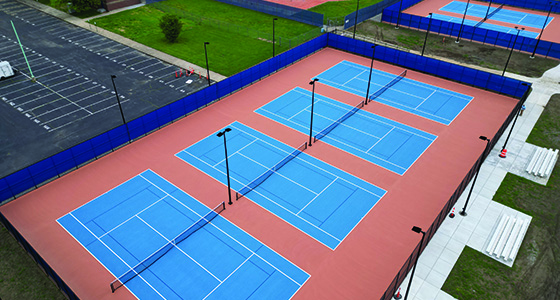
The planning team
A successful facility starts with a good planning team. The makeup of that team will vary, depending upon the specific type of project. The professionals who work on your tennis courts, for example, will be different from those who work on your basketball court or your football field.
In general, your industry partners can be categorized as follows:
- Architect/specifier/design professional: Any licensed individual or entity (for example, architects, specifiers, consultants, etc.) involved in making recommendations, creating specifications or advising the owner prior to the installation of a facility.
- General contractor: A general contractor (GC) coordinates or oversees the project from start to finish. The GC is responsible for scheduling and overseeing the physical work being done on the site and might also be responsible for construction.
- Subcontractors: Known in the trade as subs, subcontractors are skilled in specific trades, such as lighting, electrical work, irrigation, etc. In many cases, subcontractors have sport-specific knowledge, such as those who specialize in installing sports lighting or scoreboards.
- Suppliers and manufacturers: These are the people whose materials and equipment the subcontractors will be installing. In a gymnasium, they might supply basketball goals, scoreboards, etc. In a tennis facility, they might provide nets and/or net posts.
- Installer: In some cases, a GC will also act as an installer; in others, the installer is a separate person or company who physically puts into place a product. In a gym, this might be the wood flooring itself.
Your budget for the project, as well as your delivery method (design/build, design/bid/build, etc.) should be determined at this point and communicated to your designer and contractor.
Above are the members of your planning team who represent sectors of the sports facility design, construction and supply industry. Beyond this, however, there are others whose input can be invaluable to the planning process; these include the following:
- End users: The athletes who will be the boots on the ground (or perhaps sneakers on the surface) once the facility is completed.
- Maintenance staff: The people whose responsibility it will be to care for your facility should have a seat at the table. They know their capabilities as well as their limitations. A well-kept surface will last; however, one that requires too much specialized maintenance may not be the right one for your facility.
- Coaches, P.E. instructors and athletic trainers: These people are excellent sources of information on what plays well, what causes problems and what will help athletes perform their best.
What about community members? If this is an outdoor facility near a neighborhood and community members stand to be affected by issues, such as traffic or parking congestion, or if they have concerns about facility lighting, they may wish to be kept in the loop about decisions.
How do I find all these people?
Assembling the planning team means finding the right people for the job. Design professionals, for example, should understand completely the rules of the specific sports for which the facility will be used.
Good construction is essential to long-term performance.
The contractor you choose should be familiar with current products and construction techniques as well as with the type of surface to be installed and how it will affect athletes. While the owner may see the final surface, good construction is essential to long-term performance.
How can an owner find a qualified designer, consultant, manufacturer or installer? One way is to consult the American Sports Builders Association (ASBA). The ASBA website offers a free searchable database that allows users to find members in a geographic area or with a specific specialty.
The association also conducts an inquiry program, requesting information on behalf of owners from contractors and suppliers. The ASBA’s artificial intelligence program, BIRT, can help answer questions about sports facilities, too.
When choosing the professionals who will be working on your project, be sure to consider their knowledge, experience, quality, reliability, ability to stay on schedule, financial responsibility and more. Look for a contractor with specific experience building the facility you want. Ask for references. Visit other projects they’ve worked on and talk to the owners.
Ask for all proposals in writing, making sure they meet all specifications and spell out products to be used and methods of construction. Make sure each proposal details exactly what is and is not included in the contract price, understand payment schedules and retainage associated with proposals and know who is responsible for items such as permits, insurance, site prep, electrical power, landscaping, cleanup afterward, etc.
Good communication will result in a better project
Early on, some of the work being done by the planning team will involve only the school, the designer and the contractor, as well as other industry partners as needed. Later in the process, when decisions need to be made on issues such as surfacing, amenities and accessories, the larger group, including end users and others, will be helpful.
Communication is the currency of a good relationship with your planning team.
Communication is the currency of a good relationship with your planning team. Aim for transparency. Ask for regular updates on the progress of the project. Visit the site and ask questions. If you are encountering any issues (pushback from your administration, questions from parents, etc.), let your planning team know. Often, they have encountered similar issues on previous projects and can offer solutions.
Remember that unexpected problems (inclement weather, delays in shipping of materials, etc.) can throw off the schedule. If your goal is to have the facility completed by a certain date, this is valuable information for your planning team. However, know that you might need to be flexible.
Above all, be there. Be available to talk, text or answer emails when it becomes necessary. Your GC will appreciate the fact that you are open to discussions should some problem-solving be needed.
When the project is complete, make sure you keep the contact information for everyone on the team. It’s likely your school will need to upgrade something else. When it does, you’ll be ready.
You Might Also Like