
Q&A.D.: Branden Lippy on leadership philosophy, education-based athletics
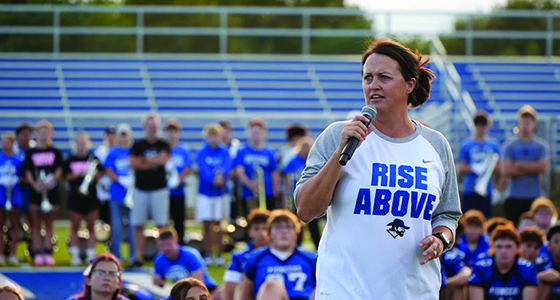
Branden Lippy spent her whole life around sports, and growing up with teachers as parents — and a dad who was a longtime high school football coach — she saw what her life could look like and never wavered.
“I was either going to be a coach or an athletic director,” Lippy said. “I knew that.”
Lippy played basketball at Millersville University in Lancaster, Pennsylvania. After earning a master’s degree and spending time coaching alongside her college coach, she moved into athletic administration, working at St. Bonaventure and the University of Maryland.However, working in Division I college sports wasn’t the dream Lippy envisioned, so when the athletic director job opened at Lampeter-Strasburg (L-S) in Pennsylvania, she jumped at the opportunity and hasn’t looked back.
“You always think of it as youth sports, high school sports, college sports, professional sports, as if that’s the ladder you have to climb to succeed,” Lippy said. “I never looked at it as taking a step backward. … I had never looked at it in any other way than I would be the leader of this athletic department.”
Today, Lippy is entering her 15th year as L-S A.D. and was recently named chairperson of the Pennsylvania Interscholastic Athletic Association’s (PIAA’s) District 3 — the first woman to chair District 3 and only the second to be named a PIAA chairperson. She also recently co-founded Interscholastic Athletics Consulting Partners, a consultancy aimed at building stronger athletic departments through an education-based approach.
In the following interview, Lippy discusses how the high school sports landscape has changed, her experience as a woman in leadership and what it means to have an education-based athletics program.
Q: How was the transition from Division I college athletics to high school?
A: When I look at what I’ve been able to build here with the administration and the school board, I am flying high. … There’s so much more to what we do in high school athletics than just winning and losing games. That’s maybe 20% of it. It’s the teaching that we do about loyalty, respect, dedication, character, integrity. That’s the stuff we’re doing 24/7.
Think of high school athletics versus college athletics and what is the difference? The difference is that college athletics is a business. Coaches are making their money to pay for their kids and their homes and their food based on what 18-23 year olds do on a daily basis. High school coaches make pennies when you think of it, but they’re invested at such a different level. It’s their kids. It’s their community. They’re putting the food on the table at night. This is something you do because you want to teach kids. … We’re not in the world of business. We’re in the world of educating.
Q: How have you seen high school athletics evolve over the course of your career?
A: It goes back to the start, which is our youth programs. … When I was growing up, it was about working through the learning process of playing a sport (and) all the things sports provide so you were ready for the junior high and high school level. Well, now that’s blown out of the water and youth sports are a billion-dollar business.That’s the biggest change that I’ve seen.
(Additionally), and this is society as a whole, unfortunately, is the disdain people have for coaches and officials. I say this often, but 90% of what we do is managing adult and kid behaviors and emotions, managing someone else’s emotions, which is the hardest thing to do. … Why have we made it OK for people to walk into a stadium and belittle and berate coaches and officials? So, that is one of my goals as we talk about leadership here at L-S is educating people on what our purpose is in high school sports, which is education-based athletics. … We have to take care of the problem in the stands, which is also creating the lack of coaches and officials.
Q: What has your experience been like as a woman in athletics administration?
A: I have made sure that I have been as knowledgeable as I possibly can so that when there is a question and somebody comes to me, I answer it. If I don’t know the answer, I’m going to say, “I’m going to find out.”
It’s very hard to be in this position if you’re incapable of having hard conversations.
I’ve talked to my colleagues about this a lot and, thankfully, they have said, “We’ve never looked at you, Branden, as a woman in this.” Whether you’re a man sitting across from me and I’m looking at him saying, “Can you do this job? I don’t care if you’re a man or a woman. Can you do this job?” That’s what’s been most important to us here. I realize that’s not everybody’s experience, certainly not every woman’s experience. … This is still a man’s job. Of the 125 athletic directors we have here in District 3 in Pennsylvania, there’s probably 10 women.
I had a father who was a football coach and we very much grew up in a tough love, disciplined environment. For my work, it has been the most helpful thing for me because I’ve learned to separate my emotions from their emotions and be able to direct conversations about what’s in the best interest of our student-athletes and have hard conversations. It’s very hard to be in this position if you’re incapable of having hard conversations. … There’s a difference, in my opinion, between ego and confidence. Ego is where you don’t know what you’re doing but you act like you do, whereas confidence is doing everything I possibly can to make sure I’m as knowledgeable as possible.
When people look to me for answers, they know they’re getting either a direct answer or something that I will look into and follow up with them and make sure they have an answer. It doesn’t matter what world you’re in, those are the aspects of a leader that people want to see whether you’re a man or a woman. It comes with time.
Q: You were recently named chairperson of PIAA District 3. What does that opportunity mean to you and what do you hope to accomplish?
A: My plan was always to continue to lead at a higher level. That is what I strive for every single day. For me just to do my job as an athletic director wouldn’t be enough for me. After 15 years, I’m not challenged enough, so I need to continue to find those leadership roles.
Being in charge is not about a title or telling people what to do, it’s about taking care of people.
In high school, I never knew who my athletic director even was, so I’ve made it a point for kids to know who I am, mainly because I want girls to see that there’s a woman in this job. I also teach at Millersville University as an adjunct professor in their sports sciences department, which is the department I went through when I was a kid. To see kids here in high school and then in my classes say, “I want to be an athletic director. Dr. Lippy, how do I do it?” That fills my heart because I want girls to see there’s a woman who has leadership ability that can sit in a room full of men and direct them on where this organization is going to go and that they can do it, too. If they don’t see it, they don’t know it.
Being in charge is not about a title or telling people what to do, it’s about taking care of people. That is what servant leadership is and it’s by far the way I lead.
Q: How do you handle the responsibility of leadership? Have you learned anything about yourself as a leader?
A: I had my track coach, who’s in his 60s, struggling with a little bit of health issues and one day he was down in our track building organizing the equipment and uniforms at the end of the season. I needed something and I went down and there was stuff everywhere. It was just him. I said, “Coach, let me help you and we can talk while I’m down here.” I stayed down there with him for an hour, helped him organize our track building, get the uniforms together and put names of who was missing. … It’s not above me to walk down there and help put away uniforms.
I don’t believe leading is about having a title or being in charge or telling people what to do. To me, leading is about figuring it out together. I feel like it’s such a simple thought, but we also know there’s so many people that struggle with it. … How do you get coaches to work for you when you don’t work for them?
It’s all about fairness and equity. I think I have a different perspective because I am a woman and I know what it’s like to play a 5:30 p.m. basketball game with 10 people in the stands and then stay for the men’s game and they have a thousand people in the stands. … I know what it’s like to kind of play second fiddle to that. I never want the girls teams here at L-S to ever feel like they aren’t as equal to the boys. So, it’s been my career goal to make sure they feel as supported as all the other teams.
Q: What does an education-based approach look like in high school athletics?
A: We build foundations on leadership, teamwork, dedication, loyalty, respect and character. Yes, those things are built at the college level, the professional level, but what is the ultimate goal at those levels? It’s winning. We’ve shifted our mindset here and I’ve always communicated to our coaches … that if we run our programs that way, wins will be the byproduct of that. … That means hold yourself to a higher standard and it’s just something we continue to talk about with coaches. If I’m at a football game on a Friday night and there’s a parent talking to me, I’m not bashing my coach, I’m not bashing the officials, I’m saying out loud exactly what I want them to hear so they know what our standards are.
Each year, we have a Pioneer Pride Classic. It’s the second day of school, we invite all our student-athletes and our coaches and they sit with their teams and it’s like a half hour where we kick off a new school year. We talk about how the last school year went with each of our teams. We let the kids speak. We give them opportunities to learn how to speak in front of people and then I give a speech. Next year, our theme is “We are one.” It’s all one team here at L-S. There’s one standard. There’s one expectation. We don’t talk a lot about rules. Rules are meant to be broken. Standards are how we build a foundation and work our way up.
Q: Are there any student-athlete programs at L-S that you’re excited about?
A: Two of our teachers and coaches here at L-S have put together a program called Monthly Mindset Meetings for our athletes. Once a month, our student-athletes go to our performing arts center and these two coaches bring in guest speakers. They talk about dedication, hard work, all those things that encompass what we do in education. Luckily we’ve been able to bring a couple professional athletes in, whether they’ve played high school sports here at L-S and became professionals or ones in the area.
Everybody wants to play college sports but nobody really knows what it means until they get there.
I think one of the things kids don’t realize, and I didn’t realize it when I was a high school athlete, is how hard the transition is from high school to college. Everybody wants to play college sports but nobody really knows what it means until they get there. It’s no longer about being the best athlete because everybody is the best athlete in college. It’s about discipline, and that is the area that is lacking.
We spend so much time at the youth level trying to create the best athlete physically that we’re missing the mark on creating the best person, the best worker. We want to walk into a gym and we want to do our business and we want to walk out with class. That’s what I tell our coaches all the time. When you’re done in high school or you’re done playing sports in college, you’re not playing sports anymore. Most of us aren’t doing it for a living, so how are you learning to get up every day, make your bed, go to work and manage all those responsibilities that you have to do to be successful? You have to be disciplined.
You Might Also Like