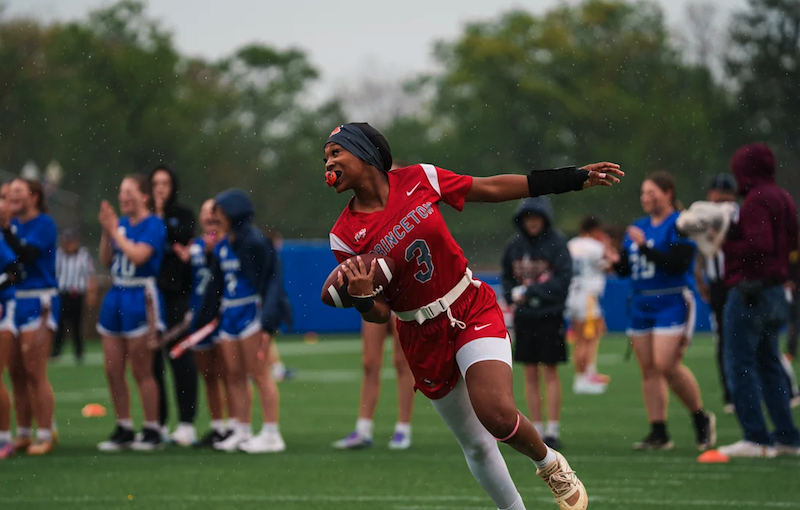
The hidden risk of sitting out girls flag football

Something is shifting in girls’ youth sports right now, and the schools that don’t see it coming are going to feel it in two or three years.
I have been having conversations with parents and middle school athletes for months, and the picture they are drawing is clearer than the conversation has caught up to at most administrative levels.Flag football is no longer a curiosity. It is no longer a trend. It is the fastest-growing girls’ sport in the country. It will be on the Olympic stage in Los Angeles in 2028 and parents of girls in fifth and sixth grade are already factoring it into their decisions about where their daughter will play her high school career. For some of these families, it has become a deciding factor.
The conventional administrative take on this is that flag football will eat into fall sports. That is the worry I keep hearing in athletic department conversations and at coaching events. The framing makes intuitive sense. Flag football is played in the fall. Girls’ fall sports are already established. New sport, same season, zero-sum problem.
I want to argue that the conventional framing is incomplete and that the real risk to most school programs is being missed entirely.
The multisport athlete walks first
Here in California, the two largest girls’ team sports outside of fall are soccer and basketball. Both are winter sports. The administrative conversation has focused on whether flag football will pull girls away from volleyball or cross country. That is a real conversation worth having, but it is only half the picture.
The girls’ families who are choosing schools based on flag football availability in fifth and sixth grade are not only future flag football players — many of them are multi-sport athletes. They are going to play flag football in the fall, basketball or soccer in the winter and a spring sport on top of that. When their family chooses a school that offers flag football, the school they chose gets all three seasons, while the school they did not choose loses all three.
That is the part I want coaches and athletic directors to sit with for a moment. The fifth-grader whose family picked a school that offers flag football is the same young woman who, three years from now, would have been on your basketball roster or your soccer roster.
You do not lose her in the fall. You lose her before she ever shows up.
Why this math gets missed
The reason the multisport math gets missed is that administrators tend to evaluate new sport offerings by season, not by athlete. The decision to offer or not offer flag football gets analyzed against the fall calendar. What does it do to volleyball? What does it do to cross country? What does it do to existing fall participation numbers?
Those are reasonable questions, but they are not the only ones.
The athlete-centered version of the question is different. Where will this young woman play her high school career — all three seasons of it? When you ask that question, the calculus changes. Schools that offer flag football have a competitive advantage in attracting multisport families, and that advantage compounds across every season the school fields a girls team.
Refusing to offer flag football to protect fall participation may end up doing more damage to your winter and spring rosters than to your fall ones. The fall sports may hold. The winter and spring rosters thin out — slowly — as families who could have chosen your school choose somewhere else four years before they ever would have suited up.
Olympic year is the inflection point
The Los Angeles Olympics in 2028 will be the moment flag football crosses fully into mainstream awareness. By then, the families currently making fifth- and sixth-grade decisions will be making high school decisions. The schools that have built infrastructure for girls’ flag football will be on the list those families are considering, while the schools that have not will be left out.
This is not a long lead time. Athletic directors and coaches should be having the offering conversation now, not after the Olympics, not after they see a competitor school pull a class of multisport athletes away from them and not after the next two recruiting cycles have already played out.
It is not folly to offer it, it is folly not to
I am not arguing that flag football is the most important girls’ sport. I am not arguing against the existing fall sports many of our programs have built carefully over decades. I am arguing that the framing of this conversation as a fall sports problem misses the part of the problem that will matter most to most school athletic programs.
This sport is here. The families have already decided. The only question left is whether your school is on the list of schools they are considering or off it.
The schools that figure this out early will field stronger rosters across every girls’ sport for the next decade. The schools that do not will spend that decade wondering where their multisport athletes went.
They went to the school that said yes.
You Might Also Like