
Cooling the game
How Legacy Building Solutions is redefining athlete safety
(Sponsored) Legacy Building Solutions delivers large, highly customized, and specialty PVC-clad structures that align with customers’ objectives through extensive research and development — all designed to create safer, higher-quality buildings. As a hybrid building manufacturer, Legacy understands the importance of a detail-oriented approach, with every aspect customized for maximum efficiency.
Legacy has a long history of producing high-quality sports facilities that are insulated and designed for fully conditioned spaces. However, schools may not have the available funding for the mechanical systems to cool these large athletic complexes, but are still challenged to find a safe practice space for their athletes within the funding limits available. Legacy has designed a unique solution that can deliver on three key needs: (1) a safe environment in the heat of the summer, (2) a bright and spacious playing space, and (3) affordability.
Some of Legacy’s most complex and beautiful projects have been designed and built for the sports community. From football to tennis to swimming, Legacy’s custom-designed structures are guaranteed to meet the specific needs of players, coaches and sports facility managers.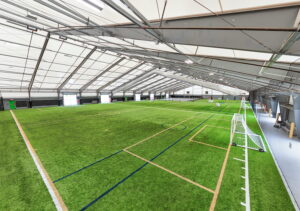
Outdoor athletes, particularly student-athletes, are especially vulnerable to heat stress, resulting in the body not being able to cool itself effectively, ultimately leading to fatigue, heat exhaustion or heat stroke. Many facilities are looking to Wet-Bulb Globe Temperature (WBGT) to effectively evaluate safe playing conditions. WBGT accounts for temperature, solar radiation, humidity and wind speed.
Shannon Humbert, business development manager at Legacy, discusses the importance of WBGT and how Legacy can improve overall athletic performance while reducing the risks of heat stress.
“WGBT looks at the overall environment of the space when looking at air movement, humidity and heat,” Humbert said. “It’s about trying to get a more accurate measurement of what the athlete’s body is feeling like when training in the heat.”
To explore the potential of shade and ventilation to reduce heat stress, Legacy conducted a 3rd-party field study in Southlake, Texas, comparing WBGT and turf surface temperatures in two environments: Outdoors in full sun (typical game/practice conditions) and indoors within a Legacy structure (shaded and ventilated conditions).
Findings show that even without the recommended Legacy ventilation system, the WBGT was reduced by approximately 9°F compared to full-sun conditions. This reduction was enough to shift UIL guidelines from “Black Flag” (no play allowed) to “Green Flag” (play allowed with restrictions).
Separately, a model simulation was performed using the most extreme heat day in recent years. The simulation calculated that a Legacy structure with the Legacy ventilation system could reduce WBGT by as much as 14.5°F.
Together, these results confirm that Legacy structures, especially when paired with the ventilation system, provide significant and reliable improvements in athlete safety during extreme heat. Based on these results, facilities in high-heat regions may rethink infrastructure planning to better align with athletic heat-safety standards.
“By using our solution, we fully enclose the structure by extending the PVC cladding to the ground,” Humbert said. “This allows us to control airflow using circular fans to maintain air movement while protecting the space from wind and rain. By transforming what would typically be a shaded pavilion into a fully enclosed, clad building, we also reduce heat risk, as the PVC material helps reflect heat.”
Unlike simple shading or basic fan add-ons, Legacy’s integrated building and ventilation solution creates a consistently cooler, safer environment, even on extreme heat days, while preserving the bright, open feel athletes and spectators prefer.
Legacy’s structures, paired with an engineered airflow package, offer a safer playing environment while reducing heat stress risks. By combining passive shade design with active air circulation, these structures lower WBGT, keep turf surfaces cooler, extend play times in extreme heat, and support compliance with UIL and OSHA heat safety standards.
In addition to performance, the unique PVC cladding plays a critical role in the overall athlete experience. The material provides the shade necessary to reduce heat gain while still allowing natural daylight to filter throughout the space. The entire roof effectively functions as a full-span skylight, eliminating the dark, enclosed feel common in traditional structures and often removing the need for artificial lighting during daylight hours.
From a cost perspective, this solution also delivers significant advantages. Schools benefit from a lower initial construction cost by avoiding expensive mechanical cooling systems, reduced ongoing operational costs due to lower energy usage, and a highly durable, low-maintenance building system engineered to withstand extreme wind and hail conditions — all backed by a 25-year warranty.
To learn more about Legacy Building Solutions, visit www.legacybuildingsolutions.com
© 2026 Legacy Building Solutions
You Might Also Like